


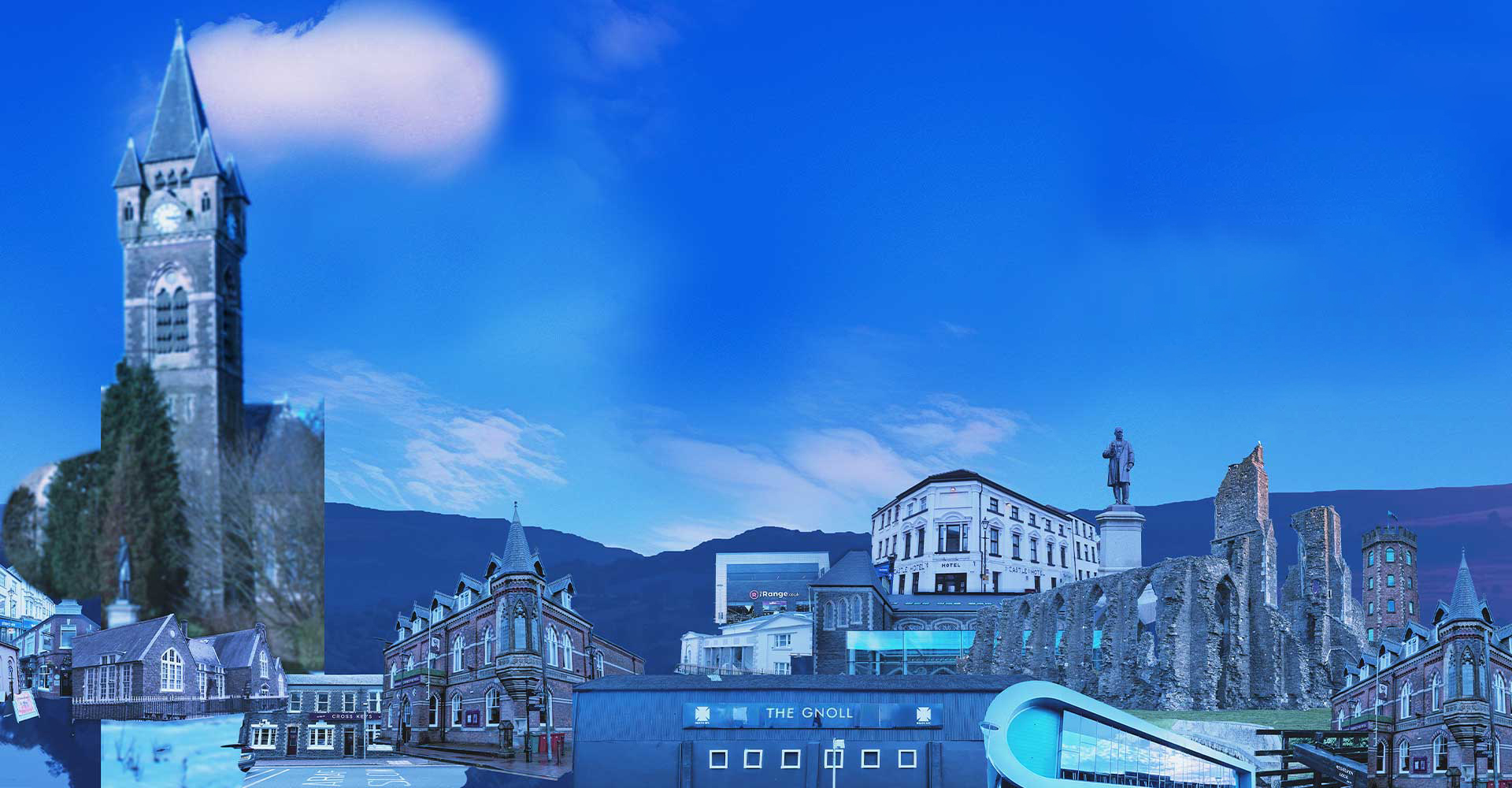

NEATH NOSTALGIA
Neath RFC entertain Bonymaen on Boxing Day (kick off 2.30pm) making it a grand day for the pubs and shops in Town with thousands of extra visitors attracted to Neath.
Neath has long enjoyed a reputation for its variety of shopping opportunities so, for those with an interest in such things, here’s a look at what was happening in the Town 125 years ago.
Three articles from the newspapers of the time :-
- Christmas & the Neath Shops
- Neath & District jottings
- Neath RFC – Christmas 1900
Don’t forget, 2025 visitors, there is plenty of car-parking opposite the ground in the new multi-storey car park (50 metres diagonally across from the turnstiles which will open at 1,00pm).
“THE CAMBRIAN” – DECEMBER 21, 1900
CHRISTMAS AND THE NEATH SHOPS
[BY OUR NEATH CORRESPONDENT.]
“He said the Christmas was a humbug as I live,” cried Scrooge’s nephew. “He believed it too.” Poor old Scrooge, and poor cold-hearted cynics of the present day who imagine that by their feeble bleating they are going to kill the dear old festival.
It still lives and it will live so long as there are children of all ages to renew their welcome to good old Father Christmas visiting us, and gladly brightening the darkest days of the whole year. A welcome did I say ? Yes a welcome such as befits a Monarch. And who so disinterested as the shopkeepers in their to some extent disinterested efforts to assist us in giving welcome to the truly “Merry Monarch.”
Despite the sad war, and the consequent depression they are yielding themselves as readily as ever to the influence of the season, and the tempting shows which they make, and which may be seen by all and sundry for nothing, have not been surpassed in any other Christmas season. These good shopkeepers deserve thanks for their generosity in making such profuse and elaborate displays for no one can really believe that selfishness prompts them to make these exhibitions. The streets are to many of our neighbours their “drawing-room” and it may be held that the shopkeepers, fully conscious of this fact, embark upon a kindly rivalry in order to afford passers-by the brightness and colour and tasteful arrangement which in the mansions of the opulent are furnished to those highly favoured persons by means of the costly pictures which adorn their walls.
As we who promenade the streets are, let us hope like others, developing a grateful state of mind, let us encourage the suggestion of fostering kindly thoughts towards our faithful friends who this year again are increasing our indebtedness to them. Regarding the town generally the displays are tasteful in the extreme and it is a matter of great regret to the writer that he is unable to give all a notice. As that is manifestly impossible he must content himself with a somewhat hurried survey and, so to speak alighting here and there, dwell for a moment or two upon the more important displays. The writer is hedged in by limitations and for these he must not be held accountable.
We must call upon Mr. Richard Allin, so well established in his business by reason of the skill and attention which he devotes to it. With a fine extent (I had almost said acreage) of plate glass windows, behind which plate glass there is a profuse array of good things which affords a source of never ending wonder to the scrutinising crowds. Excellence is written large over the whole establishment, and it is quite in accord with traditions that amongst soaps Pears’ Peerless Productions should be given special prominence. One of the old essayists says somewhere that the principal object of work is to enjoy rest and to feel that that rest has been earned. While an added charm to such rest is afforded by the use of that unsurpassable refreshing agent Pears’ Soap which most will know is the standard by which all other soaps are judged.
Occupying a truly prominent position in the best business street of the town is the splendid series of shops in which Councillor J. D. Llewelyn, J.P., conducts his ever-increasing business. He has added shop to shop, placing in them the must modern appliances, and with a staff of assistants who know how to take full advantage of the facilities provided with so liberal a hand the volume of business transacted – every wheel in the machine working with absolute smoothness – is astonishing. This is an establishment where the productions of Chivers and Sons – that delightful English firm – are kept well to the fore. Messrs. Chivers supply what may be termed the more artistic concomitants of the Christmas feast. But not only these, but the Messrs. Chivers have most agreeably solved amidst delightful natural surroundings in Cambridgeshire the problem of fruit-growing and fruit-preserving, The quaint little village of Histon has been lifted into importance by the firm named. Think of jams and jellies in absolute perfection, and the name of Chivers is sure to flit across the mind. All who as yet have not had personal experience of delights to the palate afforded by Chivers golden plum jam, Chivers marmalade, and Chivers mincemeat, not to mention other productions, will not lose time in giving themselves these several treats.
There is a marvellous combination in this vast business of Councillor J.D. Llewellyn. Artistic and prosaic articles of every kind enter through its portals to be afterwards distributed amongst a myriad homes in town and country. This is a season when youthful swains and others go buying presents and, if I may venture to suggest it, there is none more acceptable than a gift of really choice perfume. It is said that the scents of the ancients were entirely dry perfumes, such as myrrh, spikenard, and frankincense, and such like, and these were used rather to perfume the air than the person. Amongst Englishmen there is a feeling against the male sex using perfumes more especially of the heavy Oriental character. It has been laid down that an Englishman may very suitably use such perfume as Eau de Cologne or lavender water. Whether the use of such perfumes will ever become general amongst gentlemen or not, the present writer will not venture to predict but, if it does, he hopes that the choice will fall upon those inimitable productions of that physical philosopher, Sainsbury of Regent Street, formerly of the Strand. He grows lavender by the acre, and instead of allowing the winds of heaven to carry the perfumes out to sea or to the waste places of the earth, he employs his wonderful art and by a process which must ever be a mystery to mankind and womankind, he makes that delicious breath of the flowers minister to our comfort and delight. It would seem that it is Sainsbury alone who possesses a full knowledge of this wonderful secret.
Now first let us look at the famous Shop yr Oen (Messrs. D. H. Lewis and Co.). Here if anywhere in the town we shall see a truly effective display. Such was the prediction, and to say that that prediction is abundantly fulfilled is only doing bare justice to the genial proprietor of the establishment, and his clever shop front “dresser.” Never has so effective a display been made at this shop, and in making this statement I do not forget the triumphs of past years. Mr. D. H. Lewis has announced himself as a believer in coal but no one will assert that he has any connection with the plastic arts. All the same, in his windows are some beautiful objects, not in any way connected with drapery. This interpolation, so to speak, irresistibly draws public attention to the articles with which it is associated, and thus promotes their sale. What deft use is made of these embroidered sachets, and sparkling scent flasks, the latter charged with these wonderful distillations which have made the name of Labern a household word. Messrs. Labern, so Mr. D. H. Lewis will tell you, produce a charming perfume styled “White Heather” upon which the ladies, if it were suitable, would even lavish their affection. They are also decided in their praises of Labern’s Eau de Cologne and the far-farmed flower of France. So that when those best of judges, the ladies, add their favourable testimony to that of Mr. D. H. Lewis, the case in favour of Labern is complete.
This exquisitely-arranged window is Mr. Samuel Dunn’s and the window show is due to the clever brain and fingers of Mrs. Dunn. There are here choice fruits in abundance, and from all climes. Pineapples, clusters of bananas (a young gentleman from the Rhondda Valley the other day called them saveloys), Java oranges, Newton pippins, grapes in purple glory. and every possible fruit, suggesting the delights of Eden before the Fall – here they are in wondrous profusion. And more than fruits, for inside the shop are pyramids of boxes of chocolate from the famous firm of Cadbury.
In these days, when the County Council of Glamorgan has sent out its fiat that not only beer, but also sweets must be analysed so that deadly arsenic may be detected, it behoves one to buy sweets from only the old-established and reputable dealers. No one ever has been known to doubt the absolute reliability of Cadbury’s manufactures, and it is these Mr. Dunn displays with so much effect.
We next find ourselves outside the brilliant establishment of Messrs. Stead & Simpson, the firm who, in their immense boot and shoe factories, manufacture all their wares, and thus ensure first-class quality. It is really a most attractive exhibition, and the steady winning of popular favour which the manager (Mr. Huins) is happily experiencing is not at all to be wondered at.
Turning into Orchard Street we come upon a brand new Tobacconist’s shop, fitted up in the best up-to-date style – its attractiveness is noteworthy. Smokers’ requisites to suit the endless variety of tastes are displayed in the cases and ranged on shelves. This establishment is not opened on Sundays — a fact which ought to weigh with the public who believe in having a day of rest for themselves. Messrs. Glass and Roberts make an unusually fine display, the pavement in front of their shop being thronged from morning till night by sightseers intent on seeing the enormous bear giving the reindeer its final hug. This is not the only attraction to this window, as the arrangement of articles dear to the feminine heart is such as can rarely be seen.
In a corner of the general market is the office and sitting room of Mr. John Hill, the widely-known China dealer. Whilst Mr. Hill in person occupies but small space in the corner of the market as stated, his wares extend in various directions, until to the writer in his simplicity it would seem that it is a stock which will last for years. Mr. Hill smiles that characteristic smile of his, and Mrs. Hill as the observation is made and the writer is told that there are several more large crates to come in to-morrow.
Now we must hurry, for we must call at Ye Fancyries. Here there is a veritable Christmas show which all the good little boys and girls of Neath should at least be allowed to see. It is a sight which will not be forgotten. Here we may add is the depot for Windsor and Newton’s artists’ requisites of all descriptions.
Let us retrace our steps for a moment so that we may not miss what many would say is the finest show in Neath – that at the shop of Messrs. Davies and Sons, jewellers. The show is one of the Arabian Nights fancies realised. Some people talk of the deftness of Frenchmen in making effective displays. Let those persons go to see the silver and gold and choice Worcester-ware at Messrs. Davies and Sons, and they will say no more about Paris and its allurements.
Next there is Mr. Hawkins, the hatter. His shop front is as great a marvel of arrangement as ever. Who would have imagined that so effective a display would be made with stiff, neckless collars and regiments of neck-ties. But the feat is performed here, and with marvellous success.
Now for our old friend Mr. W. Inch Moore – he has always been, every inch of him, a window dresser. Curved is the line of beauty, Straight is the path of duty. These are two articles in the business creed of Mr. Moore. He carries out the first in his superb window decorations, and with charming effect, and he is absolutely true to the other in his mode of doing business. And how well Mr. Moore knows how to use decorative materials Give him a dozen boxes of Tom Smith’s Crackers and he will perform wonders. Speaking of Tom Smith, I am sure that if the children thought that Father Christmas could die they would ask for Tom Smith to reign in his stead. Who may come second as a producer of delightful crackers I am not concerned to know. This I do know, and so does Mr. Moore, that Tom Smith is far and away at the top.
We have a look at Mr. T. H. Hawkins, where there is on view a section of Madame Tussaud’s exhibition. Mr. Hawkins is much esteemed for the excellence of his wares, his ready-made clothing being of an excellent texture that even high-spirited youth are unable to wear them out.
We must take a long draught with our eyes outside the establishment of Mr. Charles Wagstaff, the Windsor Sweeteries. Whoever misses seeing this shop and its window display and its show-room and does not avail himself or herself of having some sweets dispensed to them by Mrs. Wagstaff or her niece does not live up to his privileges.
Next we have a look at Mr. Sam Arnold’s establishment where a novel display is made in the shape of a revolving exhibit in the window of an assortment of ties and collars, with here and there a bottle of perfume revealing itself. What is meant by good scent ? Why, that made from the real extract of flowers, to be sure. First on the list for purity comes the well-known brand “4,711” of Eau de Cologne in cases of dainty design, just suitable for Christmas and New Year’s presents. Mulhens’ “4,711” is prepared from the original receipt and holds a supreme position as a perfume for the sick room.
Next a call at the shop of Mr. Ivor Jones, chemist, where can be relieved and cured, so I am told, all the ills that flesh is heir to. It is a particularly bright shop and the proprietor may be seen at all times. It is not altogether a pleasing thought that he will doubtless be busy this Christmas.
The Windsor Bakery – who does not know it? Excellence of the quality of Mr. Stockham’s productions have won him the position of a tradesman thoroughly trusted. He is up-to-date in all respects and customers flock to him early and late. Next, Mr. H. L. Thomas, with his famous Southgate Stores where the specialities are Welsh bacon, Welsh ham, Welsh cheese, and Welsh butter. Mr. Thomas has made great additions to his premises and his stock is not surpassed in the town or district.
Mr. Levi James is, we can see, up to his eyes in business as may plainly be seen. All the same he can spare two minutes in which he says that he has had a busy time this Christmas – all fruit sold. Greater demand for what may be termed luxuries. While these words were being uttered a squad of assistants were clearing out what seemed to be tons’ weight of goods to load up in carts at the door of the shop. It is a grand thing to be busy and I am sure that, whatever money Mr. James secures as the result of his method, his industry and his integrity he fully deserves. One word more – A Happy Christmas to all who have accompanied me in my peregrinations.
NEATH & DISTRICT NOTES (BY WATCHMAN)
THE VALE OF NEATH.
Much has been said of the beauties of the Vale of Neath, the romantic Vale of Neath, but after all said and sung it seems a little absurd for folks to travel from Neath to Swansea via Glyn-Neath.
This was done last week, and the two travellers did not so travel for the purpose of gazing upon the scenery either. It was a murky morning and more than that the twain were engrossed, the one in reading and the other in writing. When the train reached Aberdulais one of them sweetly murmured Dynevor, and when Resolven was arrived at the other musically uttered the word Llansamlet. Nearing Glyn Neath both said together “I wonder whether we shall have to change at Landore.” The train slowed down and then stopped, and then came disillusionment. Instead of being at Landore the pair found they had travelled to Glyn-Neath. The trial was borne as philosophically as possible for gentlemen of their temperament, and a horse and trap were soon seen to be proceeding as fast as the driver could urge the horse in the direction of Neath. There was a good deal wrong that morning, and I feel that it must also be wrong to say that one of the travellers was or had been a pressman, whilst the other was a devotee of Esculapius.
SUNDAY TRAVELLING. It was Sunday travelling and as there were no convenient trains the unlucky pair were obliged to charter a horse and trap, and an attendant jehu. To walk from Glyn-Neath to Neath would for them at least have been far in excess on a Sabbath Day’s journey. Besides, walking would have been heavy as the roads were so muddy. They after sundry other adventures of a minor character arrived at Neath, gainers to this extent that they had a totally new experience added to their already large store. A tired man could I am sure find ample diversion in hearing the pair, or either of them relate the circumstances of what was in reality a flying visit to the Vale of Neath.
THE GREAT BAZAAR. This has come and gone and now we have nothing between us and the Christmas festivities. It was a brilliant affair and the workers, both ladies and gentlemen, have the satisfactory reward of contemplating the layers of bank notes and the piles of gold coins which represent the result of months’ of hard, and to some, incessant toil; and of a happy united effort at the close. “The people had a mind to work,” and can anyone tell what can long impede the progress of a people, who fully realising what is needed, apply themselves with ability, and tact, and dauntless courage, and work with persistent industry, not even pausing for mutual congratulations until the goal is won. Now all these workers may rest, and well do they deserve it. (Further notes on the bazaar are unavoidably held over).
DEATH OF AN OLD TRADESMAN. We have to record the death which took place at midnight on Friday last, of Mr. Joseph Rees, for more than fifty years a coach-builder in a large way of business at Neath. The deceased, who was a native of Cadle, near Llangyfelach, was 76 years of age. He has left a widow and a family of three sons and two daughters. One of the latter is married to Councillor Abraham George, a former Mayor of Neath. Mr. Rees was of a most active temperament, and his industry had locally passed into a proverb. The interment took place at Llantwit Corporation Cemetery yesterday (Thursday). Large numbers attended the funeral.
AND AS FOR NEATH RFC ?
Well, 125 years ago, as this year, Neath headed into the festive period on the back of a defeat when they lost nil-8 at Stradey Park against Llanelly. But Christmas 1900 brought better fortune :-
On Boxing Day, Neath brought in Walter Jenkins and J.D.D. Davis at three-quarter and Llandeilo were beaten 11-nil through tries by D.H. Davies and Joe Davies who kicked a conversion and a penalty.
And then Penygraig were overcome 3-nil when Tom Francis and Tom Beynon came into the team but the “Western Mail” described the match as “one of the most miserable witnessed on the Gnoll enclosure – comment would be superfluous” other than the try scored by Joe Davies.
NEATH V. PENYGRAIG. Neath met Penygraig for the last time this season on The Gnoil Ground, on Saturday afternoon. The All Blacks have been doing none too well this season, but Penygraig possess a much more “dingy” record. It was expected that there would not be a great deal of difference in the forwards but that Neath would be smarter behind the scrum.
The return fixture between Neath and Penygraig was played on the Gnoll Ground in fine weather. The previous engagement this season resulted in a victory for Neath. To-day Penygraig were well represented, but Neath were weak, there being no fewer than five absentees. The teams lined out as follows :-
NEATH—Joe Davies; Tom C. Davies, Tom Francis, Harry Jones, David Thomas, Willie Jenkins, Tom Beynon; Bill Jones (captain), Howel Jones, Jim Thomas, Fred Hutchinson, Mog Reynolds, Dan Davies, D.H. Davies, Rees Richards
PENYGRAIG— Tom Jones; Morris, Reed, Young, Williams; Ingram, Davies; Harry Jones (capt.), J. Griffiths, A. Mort, J. Jones, George Matthews, Griff Thomas, W.T. Owen, D.Pearn Referee: Mr. T.C. Demery (Swansea)
A very small gate, expressive of Neath’s failure in recent matches. Just after the kick-off Williams returned nicely into touch at half-way and a line-out and a couple of scrums followed in front of the grandstand. Young made his mark and found touch near the Neath 25 flag. Fielding smartly, Joe Davies just after returned to mid-field. Tom Jones returned and a moment later Young tried a drop for goal, a minor resulting.
After the resumption Walter Jenkins came prettily away from a scrum in mid-field and passed out to Beynon who found touch neatly near the Penygraig 25 flag. After the line-out a procession of marks followed, but no advantage was gained by either side. A couple of minutes later Joe Davies badly mulled and Reed experienced hard lines in not scoring for Penygraig. As it was Fred Hutchinson just managed to save, Penygraig thus forcing a second minor.
After the resumption the Neath forwards rushed the scrum in mid-field but when success was apparently within their reach one of the pack kicked too hard. Reed was given plenty of time to find touch near the Penygraig 25 flag. In the centre Harry Jones smartly snapped up a pass and looked all over a scorer when he was pulled up for an infringement which was only apparent to himself.
A scrum was ordered in the centre, and Neath were penalised for “legs up.” This brought Penygraig welcome relief and they were enabled thereby to make a temporary incursion Into Neath ground. Neath soon worked back to the centre where from a scrum Beynon broke prettily away. He passed to D. Thomas and, had the latter possessed sufficient speed, a score would have resulted. But, as matters were, Neath got no nearer than the Penygraig 25 flag.
The visitors soon got back to Neath ground, possession being due to mistakes on the part of the Neath backs. They were given a penalty but the kick failed. Scrappy play ensued in midfield, mistakes on both sides being the order of the day. Joe Davies made a good attempt at goal. Neath then warmed to their work and for some time Penygraig were penned in their own 25.
The visitors a few minutes later had to concede a minor from a powerful return from Joe Davies. The Penygraig forwards, thanks to the wretched play of the Neath halves, pushed back to the centre. Neath very soon made up leeway and were again attacking. Beynon again let Neath down badly, and, T.C. Davies holding too long, Neath were penalised near their own 25, but the kick failed.
Half-time score. G. T. M. Neath 0 0 0 Penygraig 0 0 0
Penygraig re-started, and, T.C. Davies miserably mulling on the Neath right wing, the visitors almost got over. The homesters just managed to save. The Neath skipper now re-arranged his team – Harry Jones going to half and D. Thomas to full back. It was about time, for the All Blacks were playing a wretched game.
David Thomas found touch nicely in Penygraig ground and Neath pressed. A pretty round of passing followed but Francis missed a ridiculously easy pass on the left wing, and Neath lost another opportunity. The character of the play did not improve for T.C. Davies a couple of moments later made a fatal blunder on the right by passing back to Joe Davies instead of giving to Beynon who had a clear course in.
But, notwithstanding blunders, Neath were not to be denied for, from a pretty opening by Walter Jenkins, Joe Davies romped over with a try which was not converted. This success infused new life into the home team which now kept up an incessant attack.
A blunder by Fred Hutchinson spoiled another chance and Penygraig worked back to the centre. Here play for a long time was very even and the game was most interesting to watch. Then Neath again attacked, but T.C. Davies threw another try away by trying to drop a goal instead of passing out to Howell Jones.
There was but little football in the game. As already indicated, Neath did all the pressing but their frequently-recurring mistakes gave the spectators quite a pantomimic treat. Penygraig now had their turn on the aggressive, and Morris, following up a forward movement smartly, almost got over.
After the scrum, the ball was sent back to Joe Davies who punted out of danger and within a couple of minutes Neath were again attacking close to the Penygraig line. The visitors raised the siege, and Reed narrowly missed dropping a goal.
Final score. G. T. M. Neath 0 10 Penygraig 0 0 0
REMARKS. The game was the most miserable witnessed on the Neath ground this season. At forward Neath held the upper hand all through, but their backs, with the exception of Harry Jones, Joe Davies, and Jenkins, did not do well. The Penygraig backs had not nearly so many chances as the Neath men, but they utilised them better. The bill forwards played a good game, and were dangerous on more than one occasion.